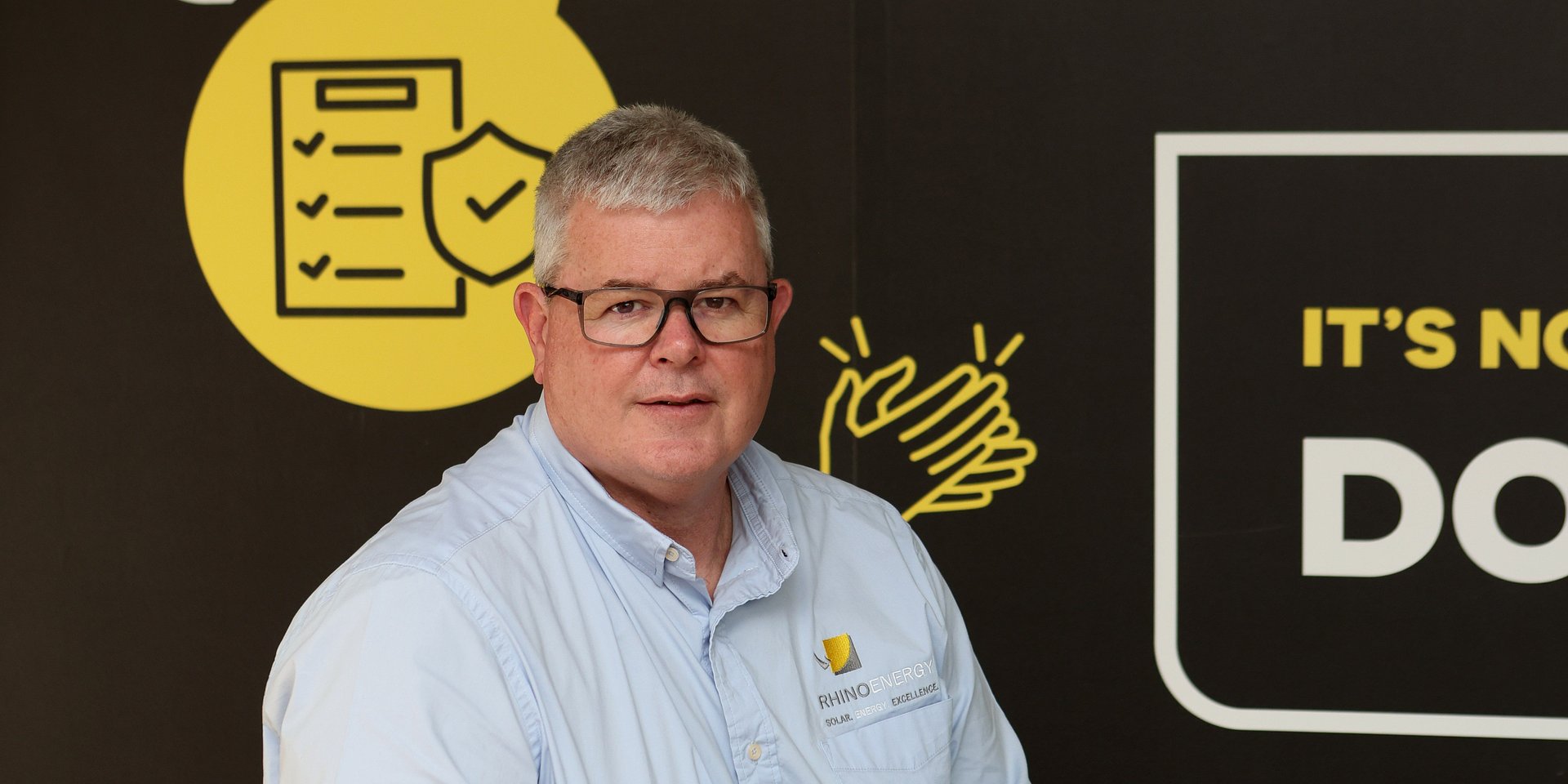
Rhino Energy Solutions says effective operations and maintenance has become the most important controllable factor in determining whether South African commercial solar and battery investments achieve their projected returns over their lifetime. According to Group CEO Rogan Davies, proactive monitoring and preventative maintenance can identify small faults before they cause significant generation losses, costly outages or safety risks, making O&M critical to the long-term performance of the country’s rapidly expanding renewable-energy infrastructure.
Rhino Energy Solutions says operations and maintenance (O&M) and not panel quality, financing structure, or even load shedding is now the single biggest determinant of whether a solar and battery investment delivers on its business case.
South Africa has installed solar and battery energy storage systems (BESS) faster than almost anywhere else on the continent over the past three years. But according to Rhino Energy Solutions (RES), a Sandton-based solar EPC+M company operating since 2007, the industry has spent that growth spurt solving the wrong problem.
“Everyone competes on the installation,” Rogan Davies, Group CEO, RES argues. “The panels, the price per watt, the time to energise. But a solar asset is a 20-to-25-year commitment, and almost every commercial failure we see happens after commissioning, not during it. Operations and maintenance aren’t a support function bolted onto a project; it's the single biggest lever on whether that project ever pays back what the business case promised.”
The industry's blind spot
Most feasibility studies and payback calculations model a solar plant's output as a smooth, predictable curve: a small annual degradation rate, applied evenly, for two-plus decades. Davies says that assumption quietly depends on a level of disciplined maintenance that a large share of the installed base simply isn't getting.
“In practice, output loss on a poorly maintained system rarely looks like gradual panel degradation. It looks like sudden, preventable faults such as a tripped breaker nobody notices for days, a battery bank drifting out of balance, cabling degraded by foot traffic and that sits undetected because nobody was monitoring for them.” Each one, on its own, looks like bad luck. Across an installed base the size of South Africa's, RES argues, it's a systemic and largely invisible drag on the return every one of these projects was sold on.
Small faults, compounding costs
Drawing on its own O&M call-out history across industrial, commercial and agricultural sites, RES has observed the same pattern recur regardless of sector: a minor, catchable issue, cable insulation worn by uncontrolled rooftop access, a breaker tripped by grid disturbances and left unnoticed over a long weekend, a battery bank whose cells are allowed to drift apart for months, all goes undetected for weeks or months before it surfaces as a generation shortfall, an unplanned outage, or, in the more serious cases, a fire or safety risk. In each case, the fault was fully preventable and fully invisible to a site with no active monitoring in place.
The financial impact compounds quickly. Davies estimates that a mid-sized commercial plant can lose 10–15% of a month's yield to a single unmonitored fault, and that an unnoticed breaker trip alone can cost in the order of R20,000 a day in unrecovered generation and emergency backup costs. None of this shows up in a feasibility study. All of it shows up in the client's actual return.
Five failure patterns the industry keeps repeating
Davies says its call-out data points to the same handful of root causes, industry-wide, again and again:
- Thermal derating from clogged fans and poor plant-room ventilation, which silently caps output during peak sun.
- Grid instability and poor municipal power quality, causing nuisance breaker trips and premature degradation of surge protection devices.
- Communication failures between plant controllers, meters and inverters over degraded networks, which distort logged generation and billing data.
- Incompatibility between older on-site diesel generators and modern PV/EMS hybrid controllers, causing inverters to reject the backup power source entirely.
- Loose bolted electrical connections that degrade over time into arc-fault risks if never inspected.
Davies flags one of these as a growing concern as sites scale up and combine technologies: controller-level coordination between BESS, energy management system (EMS) software and legacy backup generation. As more sites pair solar, batteries and standby generators to manage tariffs and grid instability, mismatches between these systems are producing more nuisance trips and rejected power, a problem he expects to become more common, not less, as hybrid systems become the default rather than the exception.
The economics of waiting
According to Davies the estimate that preventative O&M and asset management typically costs is between 1–2% of a plant's capital cost annually: “Reactive repair such as emergency labour rates, expedited parts, and the yield lost while a fault goes unaddressed typically runs three to four times higher than catching the same issue early.” Put differently, he says that the cost of proper O&M is a rounding error against the cost of not having it, and it is the single largest controllable variable in a solar plant's lifetime return.
Why O&M is the industry's next standards gap
RES argues South Africa's solar sector is repeating a pattern seen in other fast-growing infrastructure markets: installation capacity scaled quickly, while the maintenance discipline needed to sustain that installed base over decades has lagged. As the country's cumulative solar and BESS fleet grows and the Just Energy Transition depends on that fleet performing as modelled, Davies says that O&M needs to be treated with the same rigour, standards and professional recognition as engineering and installation, not as an afterthought procured on price.
That is the message Davies intends to bring to industry conversations ahead of his panel discussion at SAPVIA in October: “That the next phase of the sector's credibility with clients, funders and regulators will be won or lost on operating performance, not installation numbers.”
What proper O&M looks like
“The faults we see all have the same shape: something small and catchable that nobody was looking for, sitting for months before it becomes an outage or a safety risk. That's not a technology problem, it's a maintenance-model problem and it's the single biggest reason a solar investment underperforms its business case.” says Davies.
He says that RES structures its own O&M offering around prevention rather than break-fix response. Before a technician is dispatched, the team runs diagnostic checks across its monitoring platforms to pinpoint the exact fault mechanism, removing the guesswork of on-site troubleshooting. Where possible, faults like breaker trips are resolved remotely within minutes. Scheduled maintenance includes drone-based thermal imaging across PV arrays and switchgear, catching micro-arcing, hotspot degradation and loose terminations long before they become safety hazards or unplanned downtime.
“We tell every prospective client the same thing before they sign: ask your EPC partner what happens after commissioning, not just what happens during it. That single question tells you more about your future returns than almost anything in the proposal.” Davies adds.
A practical maintenance cadence
RES recommends the following inspection and maintenance cadence as a baseline for commercial and industrial solar and BESS sites, offered as a starting reference for businesses assessing their own or a contracted O&M programme:
| Frequency | Preventative Actions |
| Daily | Track string-level generation, Performance Ratio (PR) and active fault codes. |
| Quarterly | Module cleaning tailored to dust levels (monthly for heavy industrial/agricultural sites, quarterly for standard commercial). |
| Bi-Annually | Clean and replace inverter air-intake filters and service heat-exchanger fans to prevent thermal derating. Perform mechanical torque audits on high-stress AC and DC terminations to eliminate thermal loosening. |
| Annually | Conduct drone thermal imaging on PV modules, AC and PVDB switchgear. |
Ends.
About Rhino Energy Solutions
Rhino Energy Solutions is a South African renewable energy EPC+M (Engineering, Procurement, Construction and Maintenance) company with a 19-year track record of delivering solar and battery energy storage systems across the industrial, commercial, agricultural and mining sectors. With a portfolio spanning 87 MWp of installed capacity and clients including blue-chip organisations across Southern Africa, Rhino Energy designs, builds and maintains large-format energy solutions that reduce costs, improve operational resilience and support ESG objectives. For more information, visit rhinoenergy.co.za.
For more information contact:
Samantha Hogg-Brandjes | GinjaNinja | +27844584857 | samantha@ginjaninja.co.za